School District Tax Measures February 10th 2026
Last updated: February 18th, 2026
As analyses are completed, summary results will be provided on this page.
Contents
- Summary
- Overview
- Highlights
- Incomplete Local Voters’ Pamphlet (LVP) tax measure descriptions
- Tax measure details
- All tax measures (bonds, enrichment levies, capital levies) by county
- Bond summary
- Total bond cost to local taxpayers
- Total bond cost to owners of properties with 2025 assessed values of $500,000
- Total local property taxpayer costs of all measures
- Calculator methodology
- Proportional Obligation Factor (POF) proof
Summary
Overview
Listed below are the types and counts for the tax measures for the February 10th 2026 election that have been analyzed to date:
- Bonds: 13
- Capital Levies: 49
- Enrichment Levies: 124
Highlights
Incomplete Local Voters’ Pamphlet (LVP) tax measure descriptions
Most (75+%) of this election’s new multi-year Enrichment Levies are significant tax increases in dollars over their previous multi-year Enrichment Levies. But from the descriptions
in the LVP, those tax increases are not clearly shown to voters. For example, the Mukilteo SD in Snohomish County has an Enrichment Levy that is a 42% increase in dollars. See Figure 1.
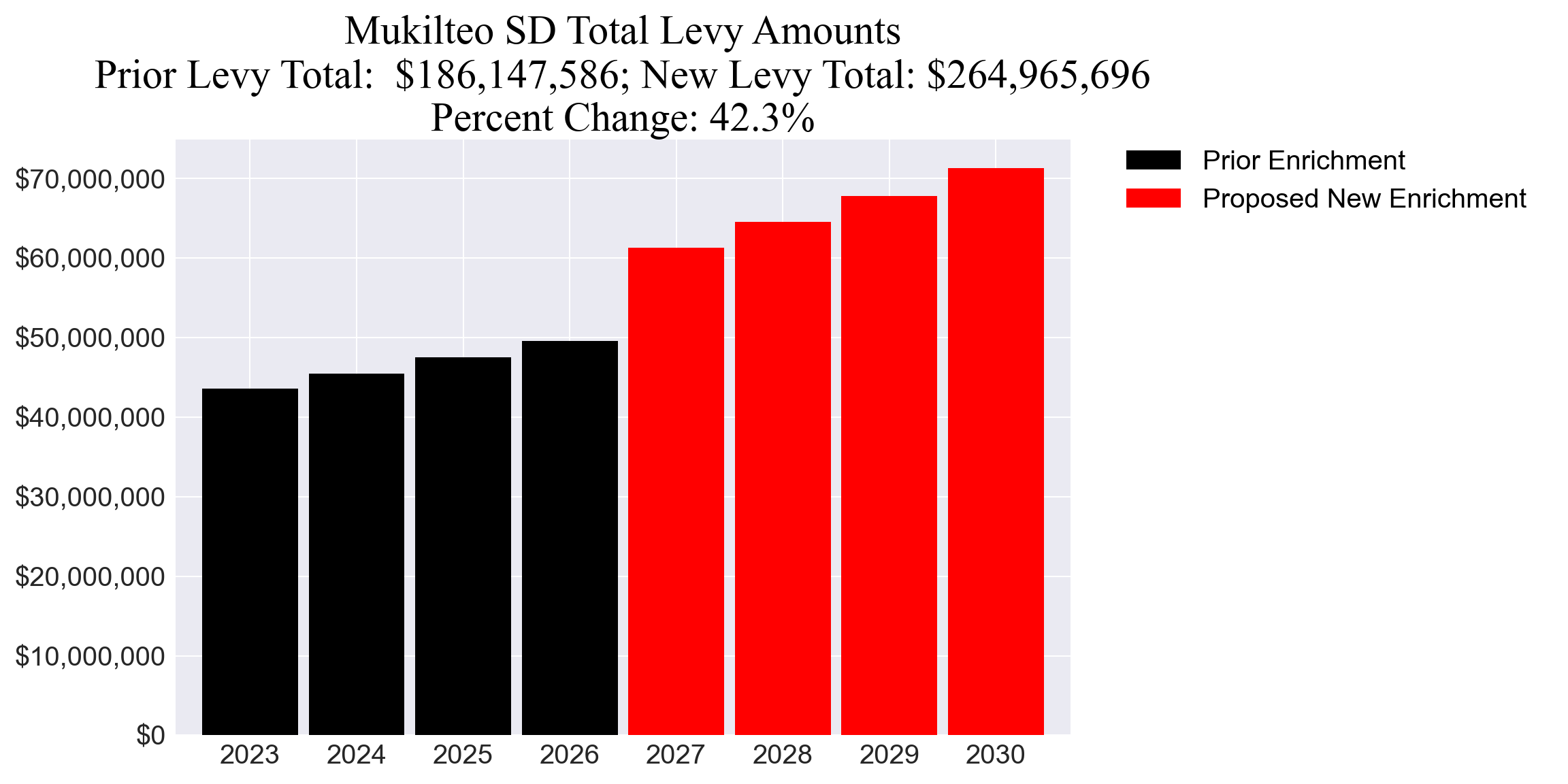
Figure 1.
However, the LVP description states that the Enrichment Levy is a replacement for an expiring levy. That gives the impression that voters are voting to continue a levy tax at the same amount, in dollars, as the previous levy. See Figure 2.
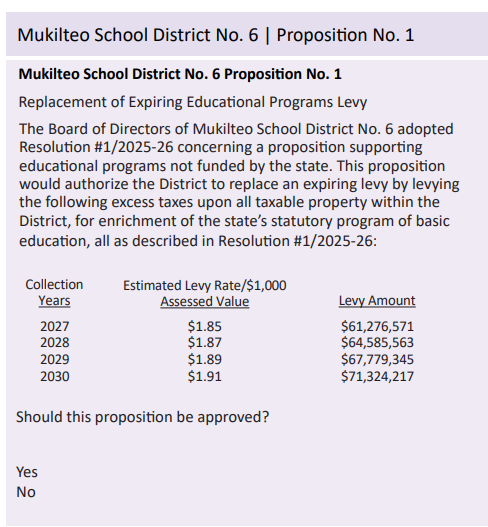
Figure 2. LVP Snapshot, Mukilteo SD Enrichment Levy.
There is no mention of the 42% increase in dollars. What is presented is a table showing 3 columns: the Collection Years, the district’s Estimated Levy Rate per $1,000 of Assessed Value, and the Levy Amount. That 2nd column showing the Estimated Levy Rate should be prohibited from the LVP and from all of the district’s campaign materials. The reason is that it is mathematically incomplete. The district needs to also show their assumption for Total Assessed Value (TAV) changes in each future year. Voters/taxpayers will then need to multiply their property’s current year assessed value (AV) by those assumed future year TAV changes and then they can use the district’s Estimated Levy Rates. Or better, the district and the county elections department should only show the “Effective” Future Tax Rates which would be the district’s Estimated Levy Rates multiplied by the assumed TAV changes, compounded. See Figure 3
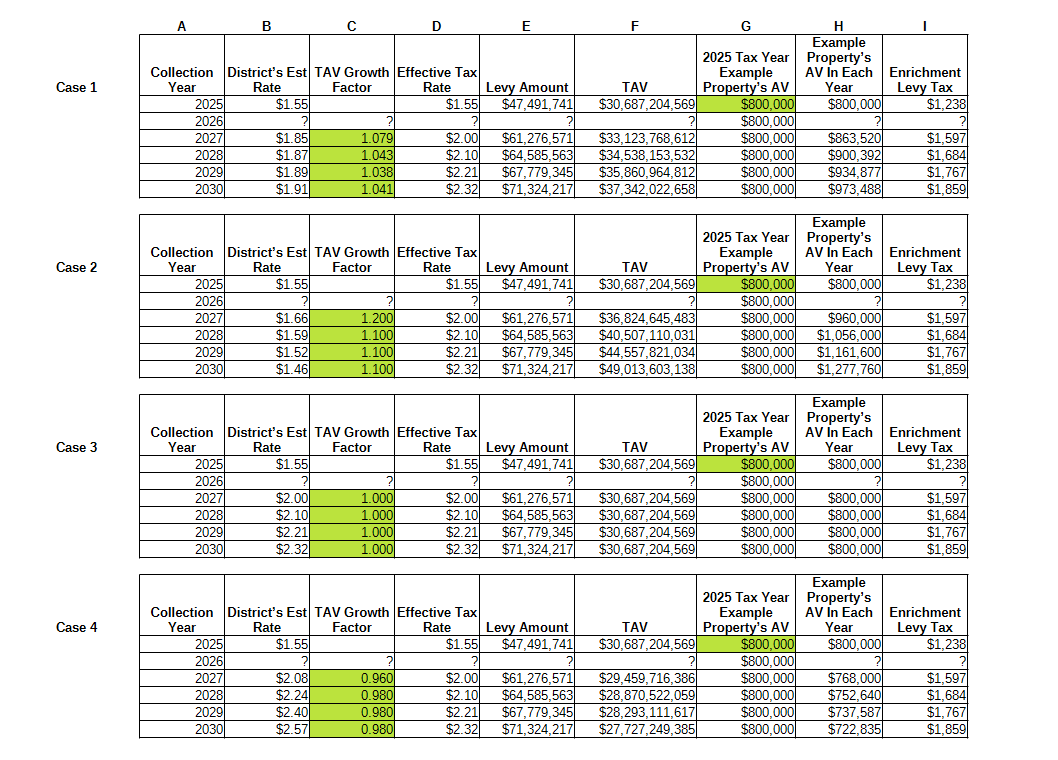
Figure 3.
Figure 3 also shows several cases.
Case 1 is the district’s assumption for TAV changes. They are assuming an 8% increase in TAV from 2025 to 2027. Note that this analysis had to leave 2026 open since the 2026 property tax information will not be available until a few days after the February 10th election. This is another reason why February elections should be eliminated. The district is assuming a 4% increase in TAV, compounded, for years 2028 through and including 2030.
Case 2 is if one assumes a 10% increase in TAV in each future year.
Case 3 is if one assumes no change to TAV in each future year.
Case 4 is if one assumes a 2% decrease in TAV in each future year.
The reader will note that the Effective Levy Rate (column D) does not change between any of the cases. And the amount in dollars (taxes to collect, column I) in each future year that the owner of the example property will pay has the same escalating amounts in each case. Only the District’s Estimated Levy Rate changes between the different cases.
The next example is from the Northshore SD in King County. The Northshore SD is running a bond - the largest bond in the state for this election. See Figure 4 for the LVP description.
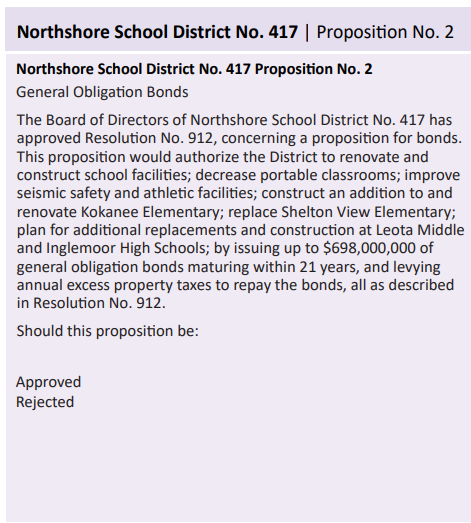
Figure 4. LVP Snapshot, Northshore SD Bond.
The description mentions the bond principal of $698M and the maturity of not more than 21 years. But the description does not mention the estimated bond interest and fees that are an additional $450M bringing the total bond costs to local taxpayers of $1.148B. Also not mentioned is the existing bond debt payments still to make of $1.019B The planned escalating taxes to collect each year are also not mentioned or shown as they should be if school districts and other taxing districts in WA had to follow TILA (Truth In Lending Act) guidelines.
A more complete picture of what voters are voting on for this bond is presented on this website and repeated below in Figure 5.
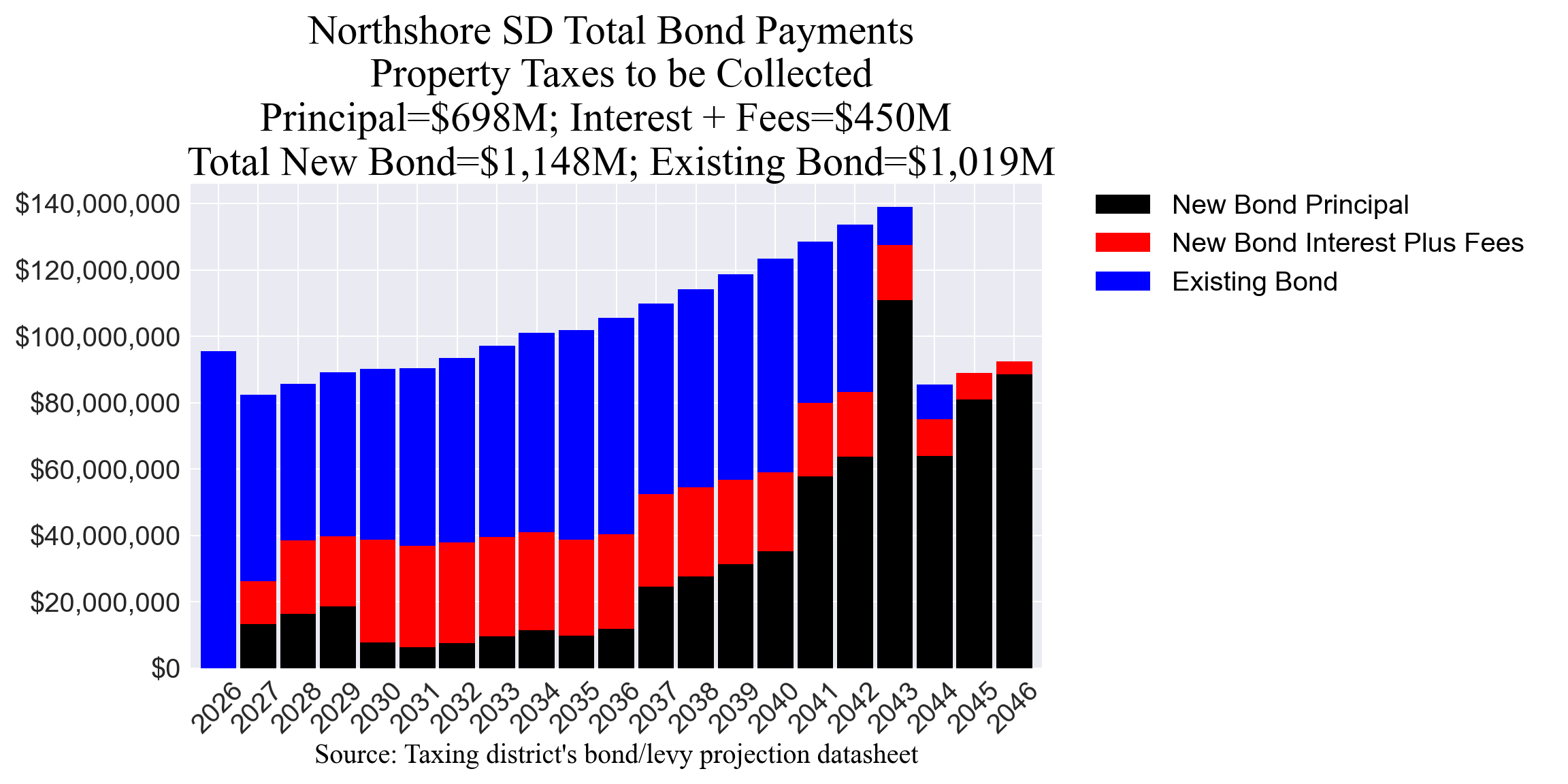
Figure 5.
An example of a school district tax measure that correctly uses and displays the “Effective” future tax rate in its tax measure description in the Local Voters’ Pamphlet is the Boistfort SD in Lewis County.
Lewis County School District Tax Measures
Tax measure details
All tax measures (bonds, enrichment levies, capital levies) by county
Bond summary
Total bond cost to local property taxpayers in each school district tax area with a bond measure
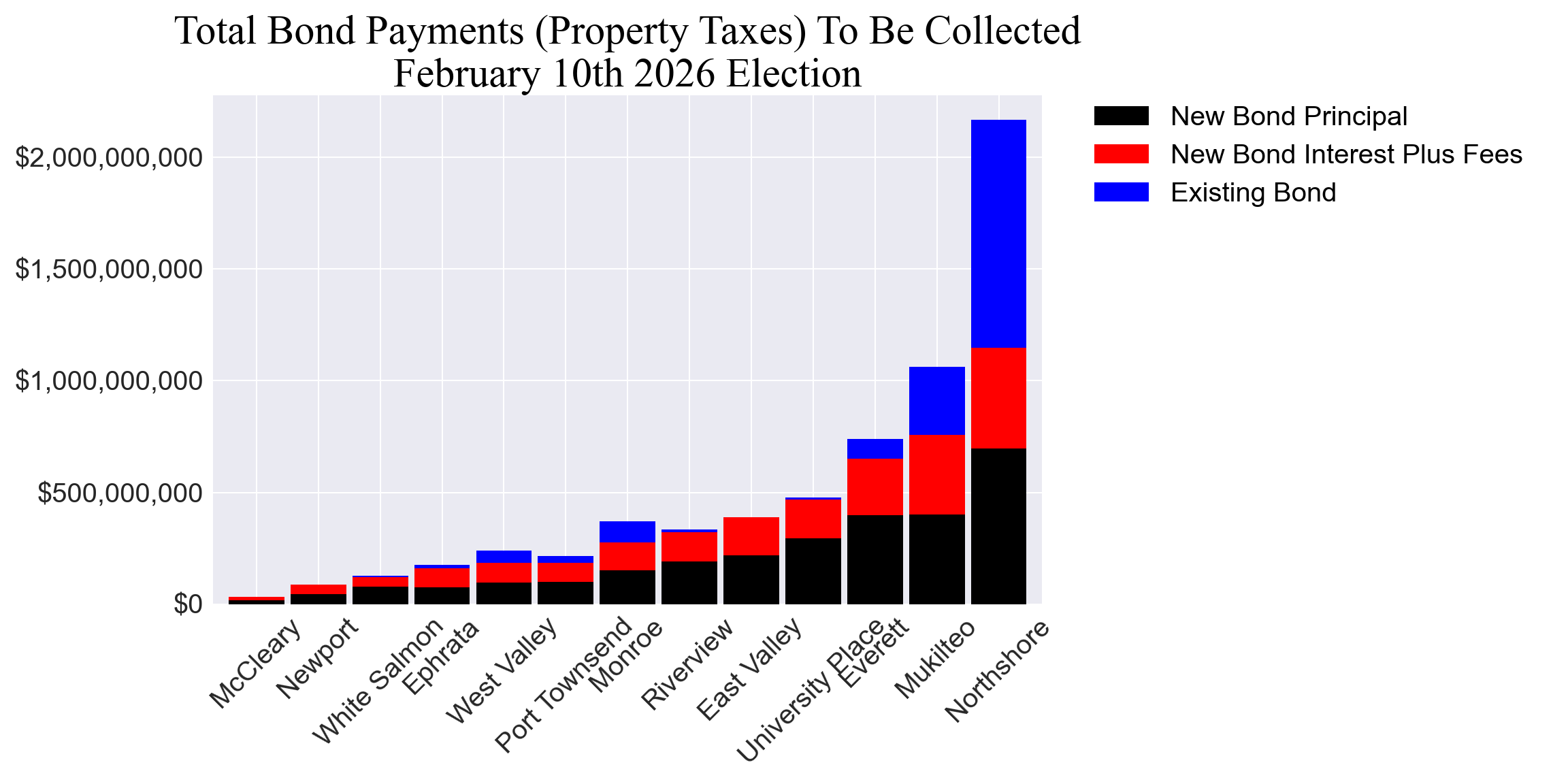
Figure 6.
Data source: Each district’s bond/levy projection datasheet
Total bond cost to owners of properties with 2025 assessed values (AVs) of $500,000
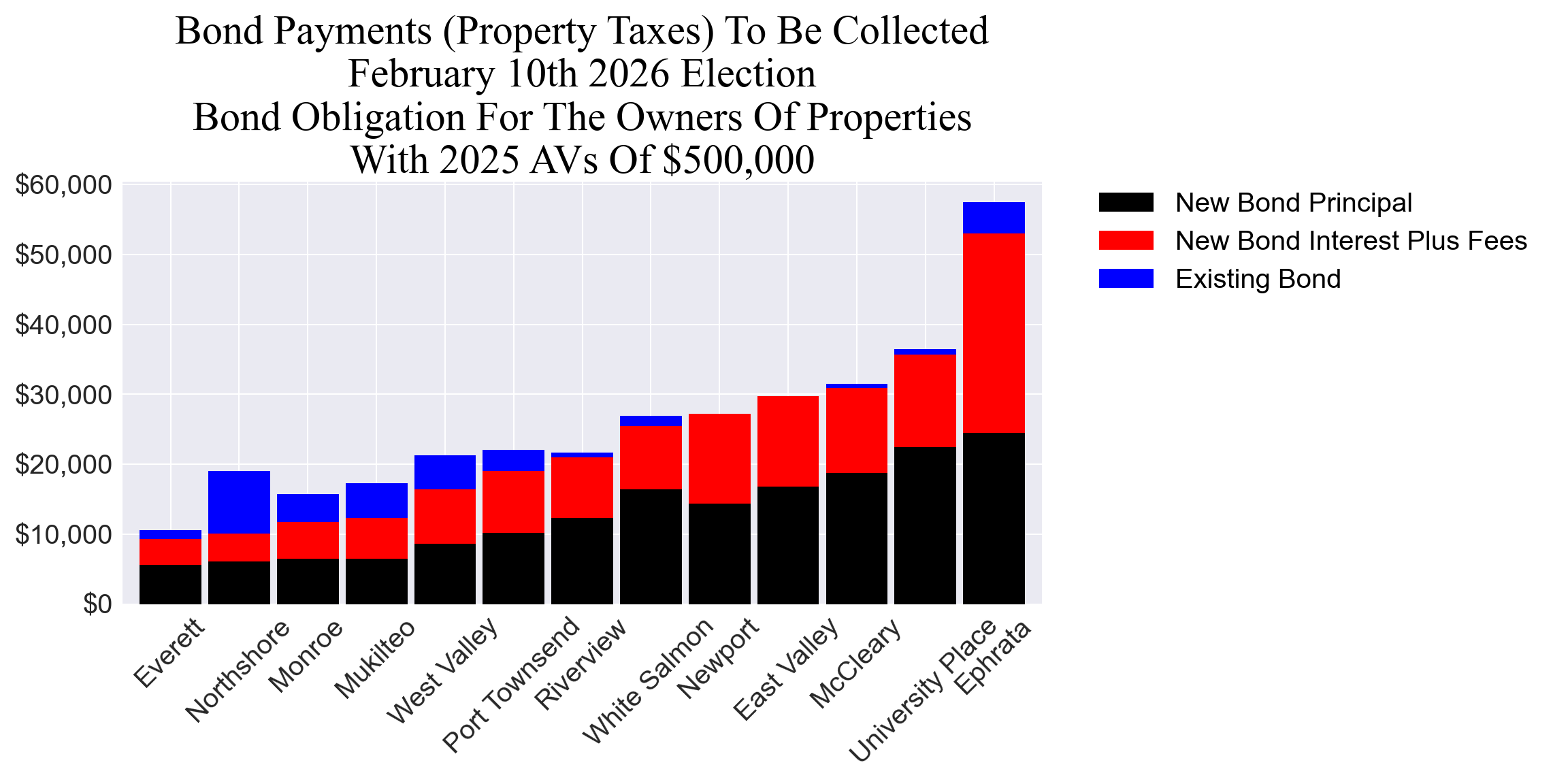
Figure 7.
$500,000 was chosen since it is approximately the median of the median home AVs in the school districts with tax measures.
The conservative assumption used was that the POF (proportional obligation factor) as of 2025 remains constant over the term of the bond. The interested reader can use the cost impact estimating calculators (linked in the measure details by county section of this report) for the bond and district of interest. An annual POF change parameter can be entered in the calculators as well as different AVs. The county assessor’s office can assist with calculating the historical POF change parameter for any property. The POF = (The example property’s AV for a given year) divided by (The Total AV of all properties in the district’s tax area for the same year).
See the Calculator Methodology section below for more details.
Total local property taxpayer costs of all measures
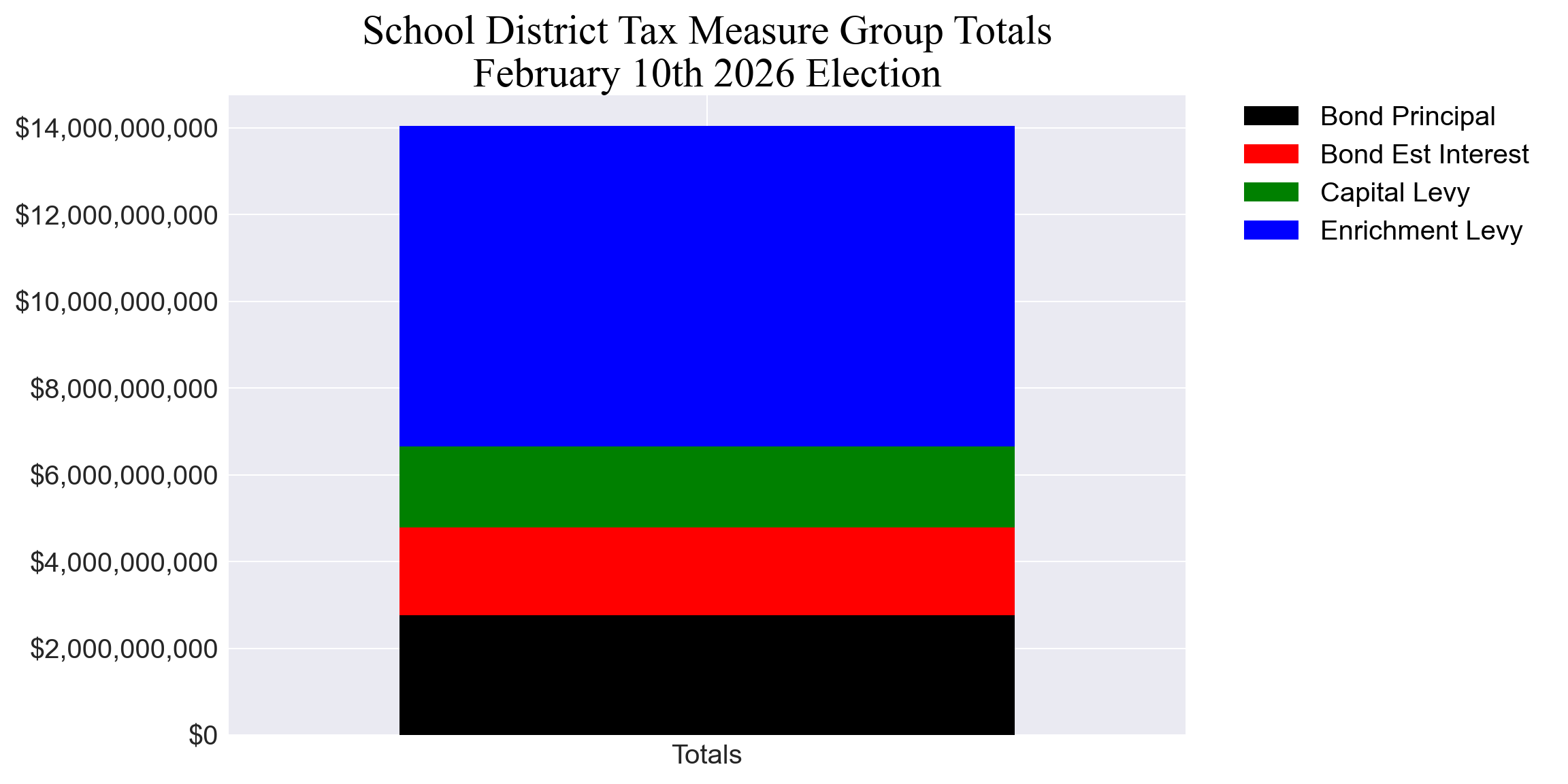
Figure 8.
Bonds
Number of bonds: 13
Tax (repayment) durations: 19 – 26 years
Total bond principal: $2.8B
Total bond estimated interest: $2.0B
Total bond principal + estimated bond interest: $4.8B
Capital levies
Number of capital levies: 49
Durations: 1 – 6 years
Total capital levy amount: $1.9B
Enrichment levies
Number of enrichment levies: 124
Durations: 1 – 4 years
Total enrichment levy amount: $7.4B
Capital and enrichment levies
Total levies: $9.3B
Bonds, capital and enrichment levies
Total levies + bonds (principal + interest): $14.1B
Calculator methodology
School district reps often say they need to correctly guess the future Total AV for their district’s tax area for each of the future years of their tax measures. Their assumption is incorrect and ends up misleading voters/taxpayers. And district reps’ incorrect logic also usually leads to underestimating the true costs of their measures to taxpayers.
In contrast, for the property tax impact estimate calculators on this website, the author uses a Proportional Obligation Factor (POF) method.
Using the latest available Total District Assessed Value (AV), the POF of the example property was calculated:
POF = (2025 Example Property AV) / (2025 Total District AV)
The POF was then multiplied by the total amount that the district expects to collect each year for the duration of the measure in question (bond or levy) to obtain the estimated taxes for the example property for the measure.
Using this methodology, it doesn’t matter if all properties increase in AV by 20% or all decrease in AV by 20% (which could happen in a recession). The tax collection schedule shown in the charts and tables would still apply for the example property. The example property’s proportion of obligation for the bond debt or levy remains the same over the bond payback or levy period. Tax rates, however, would change. If all properties increase in AV by 20%, the tax rate for the measures would decrease by approximately 20%. If all properties decrease in AV by 20%, the tax rate for the measures would increase by approximately 20%.
Note for the POF annual change parameter for the enhanced calculator versions:
For properties that are increasing in POF (Proportional Obligation Factor), a positive POF annual change will give more accurate results. For properties that are decreasing in POF due to rapid new construction or for other reasons, a negative POF annual change will give more accurate results. However a value of 0 will generally be slightly conservative and will generate estimates that are usually within 5% of actual costs.
It is the author’s opinion that county assessors (in all 39 WA counties), using sound accounting principles, should be providing these calculators for their constituents.
Example calculator calculation:
Centralia SD for their 2023 Enrichment Levy tax measure
Total District AV for 2023: $4,131,948,094
Example property’s AV for 2023: $350,000
POF for 2023 assumed to be the same for years 2023 - 2025: $350,000 / $4,131,948,094 = 8.471E-05
Enrichment Levy amount to collect in 2024: $6,700,000
Example property’s 2024 tax for the Enrichment Levy: POF * (Enrichment Levy amount to collect in 2024) = 8.471E-05 * $6,700,000 = $568
Similarly for the year 2025
Enrichment Levy amount to collect in 2025: $7,600,000
2025 tax = 8.471E-05 * $7,600,000 = $644
POF proof
For any particular future year:
(1) {Tax For An Individual Property For The Year} = {Tax Rate For The Year} X {Property’s AV For The Year}
(2) {Tax Rate For The Year} = {Known Total Tax To Collect For The Year} / {Total AV For The Year}
The apparent problem is that the {Property’s AV For The Year} is not known and the {Total AV For The Year} is not known. That’s 2 unknowns. But we have 2 independent equations. 2 equations, 2 unknowns. Algebra to the rescue.
We can substitute {Tax Rate For The Year} from (2) into (1)
(1a) {Tax For An Individual Property For The Year} = {Known Total Tax To Collect For The Year} / {Total AV For The Year} X {Property’s AV For The Year}
But {POF} = {Property’s AV For The Year} / {Total AV For The Year}
Therefore:
(1b) {Tax For An Individual Property For The Year} = {Known Total Tax to Collect For The Year} X {POF}
POF stays relatively constant for an individual property over many years and regardless of how properties values are rising or falling. The POF for an individual property can be accurately calculated for the current year and used for future years.
Individual properties’ AVs and therefore Total AVs substantially fluctuate from year to year.
This is why even if guesstimated future Total AVs (and therefore future guesstimated tax rates) were accurate, they are not necessary. And worse, future guesstimated tax rates can be set to almost anything by just adjusting the guesses for future Total AVs. Select a higher future Total AV growth, then the future tax rate will be lower. Select a lower future Total AV growth, then the future tax rate will be higher. However, the POF for an individual property does not change as property AVs rise or fall. School districts and other taxing districts should be prohibited from stating their guesstimated future tax rates on their tax measure resolutions and in their campaign materials. That practice misleads voters. School districts, of all institutions, should teach and practice proper logic and mathematics, accurate financial analysis, and ethical behavior.
Voters/taxpayers are voting on amounts in dollars - not guesstimated, inaccurate, future tax rates. This is why TILA (Truth In Lending Act) rules should apply to school district levies and bonds.
If school districts still want to show future rates for their new measures, they should then assume no change in Total AV from the current year and THEN calculate their future rates. Citizens can then calculate their future levy amounts based on the value of their properties’ current year AV.
See the Northshore SD example bond calculator to demonstrate how future guesstimated tax rates are meaningless:
Link to the Northshore SD example